From recordings to labels
The dataset used in our experiment consists of 1,501 audio recordings from the Dominica Sperm Whale Project (DSWP) public HuggingFace release, orrp/DSWP. The acoustic collection is associated with the WhAM study. Labels are reconstructed from DominicaCodas.csv, using its codaNUM2018 index to match the DSWP file indices.
The resulting dswp_labels.csv gives one row per recording, including social unit, coda type, individual annotation, date, click count, duration, and annotated inter-click intervals. Reconstructed metadata place these codas in 2005–2010 and clan EC1. This is the date range of our reconstructed subset, not a claim about every recording in the public release.
The clean set contains three social units (A, D, F) and 22 coda types. All tasks share coda partitions. Task-specific eligibility is applied within those partitions, rather than creating a separate identity split that can overlap encoder training.
Individual identification uses 754 codas from 11 identities. The clean set also contains 620 unknown-ID codas, eight ambiguous two-individual annotations, and one identified singleton. Those 629 codas are excluded from ID training/probing but remain eligible for unit and type evaluation. Eligibility requires an unambiguous positive integer identity with at least two observations in the clean collection. A valid identity can still be unsupported in a particular test split when it is absent from that split’s training set.Identity eligibility and missingness
What does a coda look and sound like?
A coda is a short sequence of clicks. The spacing between clicks provides a rhythm representation; a log-mel spectrogram also retains the frequency content and temporal structure of the full signal. Select one of three real recordings below. These are illustrative examples selected by type, not a representative sample or evidence for a model ranking.
Coda 12
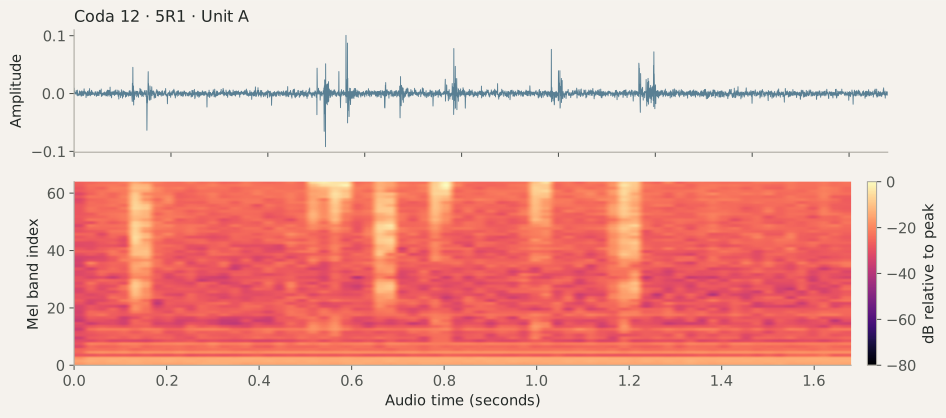
The displayed spectrogram uses mono audio resampled to 48 kHz, a 2,048-sample FFT, 1,152-sample hop, and 64 mel bands over 0–8 kHz. Power is shown relative to the segment peak with an 80 dB range. Unlike the model input, this display does not include fixed-length padding. Playback retains the native sample rate and is reencoded to mono PCM for browser compatibility.
The annotated ICI sequence describes intervals between successive annotated clicks. It is not overlaid as an absolute onset track: the timing of the first annotated click relative to the audio file is not established here. Audio-file duration and annotated first-to-last-click duration can differ.
Class balance changes how we evaluate
Unit F contributes 821 of the 1,383 clean codas (59.4%). Predicting F for every recording would therefore produce an apparently substantial accuracy without recognizing either of the other units. We report macro-F1 so that each scored class contributes equally, and use balanced class weights in the linear probes. The current DCCE runs use uniform shuffled sampling, not the unit-balanced sampler from earlier experiments.
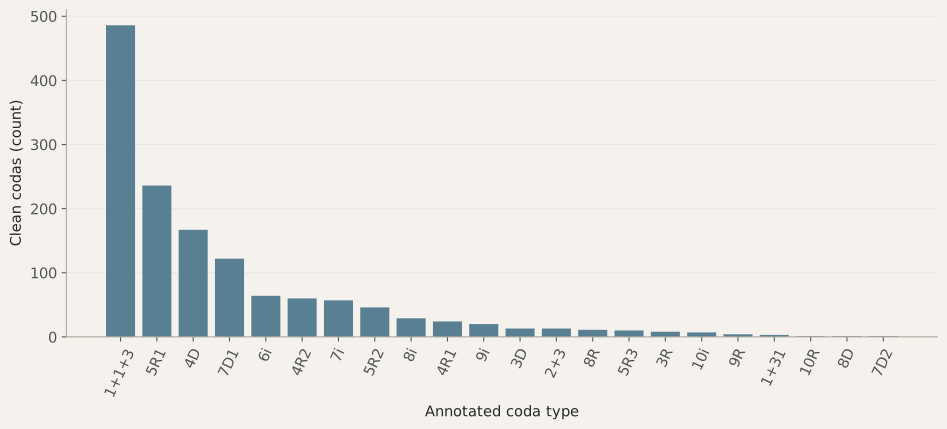
Type labels are themselves defined through click count and timing. A strong raw-ICI type classifier is therefore an important annotation-based reference. Its performance must not be interpreted as a waveform-only recognition result.
Duration, click count, and timing
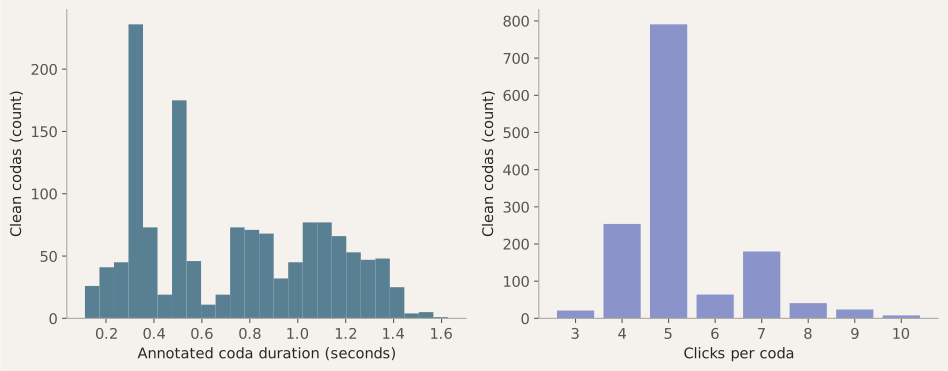
Annotated duration has a median of 0.718 seconds and ranges from 0.1121 to 1.6265 seconds. The evaluated codas contain up to ten clicks, producing at most nine ICIs. These short sequences motivate a compact recurrent rhythm encoder.
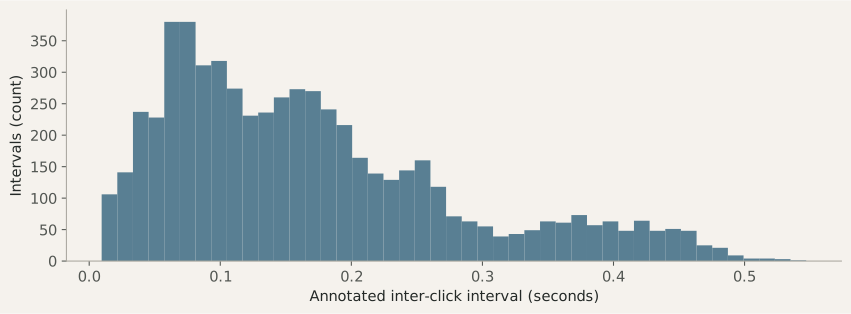
These visualizations describe the full clean dataset. They do not fit any transformation used by the experiments. Model and probe scalers are fitted only on training examples, as described in the evaluation chapter.
Recording context is part of the data
The native audio rates are 44.1, 48, 96, and 120 kHz. Different recording conditions can leave acoustic traces that are unrelated to the biological target. Year and social unit are associated in this dataset, so a random split alone cannot establish transfer to independent recording contexts.
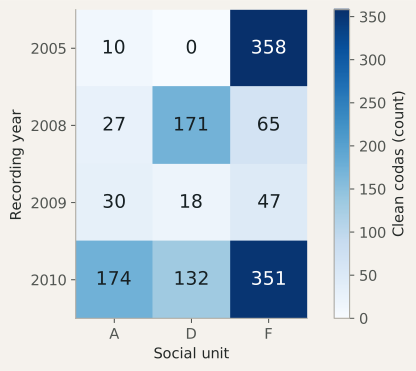
Dates are proxies for recording sessions, not verified session identities. The study evaluates both date-disjoint folds and complete year holdouts, while retaining the limitations of sparse class support and a single population.
Evidence and provenance
The charts on this page were generated from the saved clean label table and three available audio files. They are descriptive additions for the website, not new fitted models. The original EDA notebook preserves the earlier investigation, including interpretations that were later revised. Read it with the research record.
- Reconstructed labels
- Audio-example metadata
- Descriptive summaries and plotted result values
- Original DSWP release and its license
Audio attribution: Dominica Sperm Whale Project, distributed through orrp/DSWP. The release identifies CC BY 4.0; the browser excerpts are converted to mono PCM. Annotation reconstruction follows the sources documented in the paper. This site does not independently revalidate the historical audio-to-annotation join.