Year and unit are associated
Explicit day/month/year parsing includes all 1,383 clean codas. Year-by-unit counts are 10/0/358 in 2005, 27/171/65 in 2008, 30/18/47 in 2009, and 174/132/351 in 2010, for units A/D/F respectively.
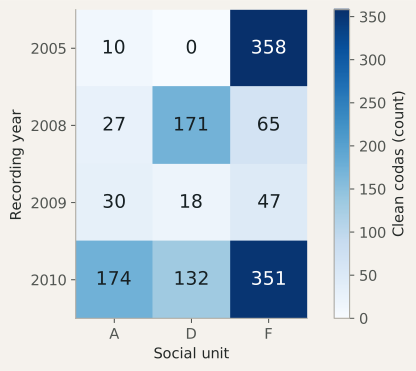
Pearson χ² is 530.04, with six degrees of freedom. Uncorrected Cramér’s V is 0.438, computed as √(χ² / [1,383 × min(3,2)]). This quantifies association in the dataset. It is not proof that a model causally relies on recording artifacts.
Recording-date holdouts
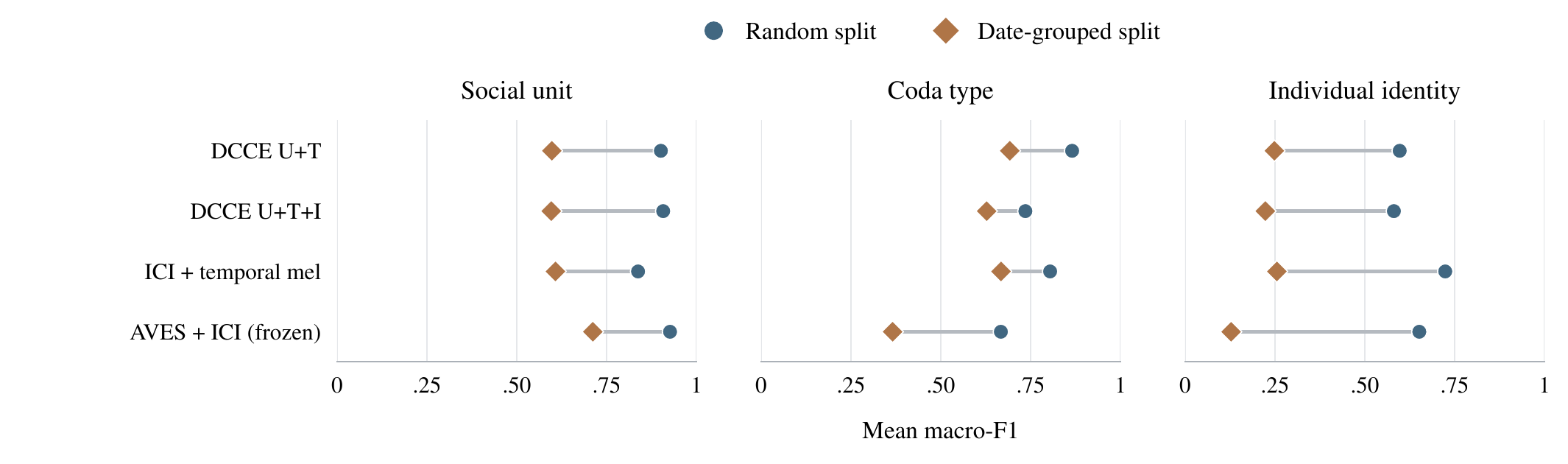
Grouped means are lower across all three tasks for the four illustrated models. Task orderings also change. For DCCE U+T, identity moves from 0.597 ± 0.051 under random splitting to 0.248 ± 0.130 under date-grouped evaluation. U+T+I moves from 0.581 ± 0.012 to 0.223 ± 0.175.
The grouped identity folds contain 186/213, 111/121, and 145/145 supported/eligible examples, spanning three, six, and six scored identities. The difference between protocols therefore combines changes in recording context, supported populations, and partitions. It cannot be read as an isolated “recording-context penalty.”
Hold out an entire year
Holding out 2005/2008/2009/2010 yields unit macro-F1 of 0.592/0.362/0.767/0.346 for DCCE U+T and 0.448/0.391/0.713/0.357 for DCCE U+T+I. Both variants are below frozen AVES in every year.
| Held-out year | DCCE U+T | DCCE U+T+I | AVES frozen |
|---|---|---|---|
| 2005 | 0.592 | 0.448 | 0.750 |
| 2008 | 0.362 | 0.391 | 0.510 |
| 2009 | 0.767 | 0.713 | 0.833 |
| 2010 | 0.346 | 0.357 | 0.377 |
Each year uses one fit. The 2005 test set contains two units; the other years contain three. These are different test populations, not four interchangeable estimates of one score. The complete held-out-year report and machine-readable results retain the other tasks, coverage, and additional controls.
Identity depends on the candidate pool
The biological motivation already suggests that identifying a caller can depend on coda type and which animals are compared. Gero et al. reported that timing-based individual discrimination changes across types and within-unit versus pooled candidate sets. Our selected diagnostics examine related dependencies without claiming to replicate that study’s protocol.
For the 1+1+3 type, DCCE U+T’s grouped-fold identity macro-F1 is 0.000/0.233/0.234, using 52/53/34 codas and 3/3/4 identities. Single-identity strata are unscored. These values were independently recalculated from the retained predictions.
Separate within-unit probes require at least two supported identities in training and test. Only unit F supports these probes across all three grouped folds. Its mean ID macro-F1 is 0.384 for raw ICI, 0.267 for DCCE U+T, and 0.238 for DCCE U+T+I. These reduce one group-membership shortcut without removing all type or recording-context dependence.
Limits that further local runs cannot resolve
The study contains one Dominica population, three units, and a single clan. It does not include explicit vowel labels for these 1,383 codas: available hand-annotated vowel metadata refer to different identifiers. The spectral branch receives contrastive and optional ID supervision, not explicit phonological categories.
Dates are not verified sessions. Historical foundation-model pretraining membership is unavailable. Sparse identities and three-run main comparisons limit precision. These constraints require additional evidence or different data, not merely more runs on the same codas.
The results motivate independent recordings and explicit annotation budgets for future comparisons. They support studying timing and spectral information as separate inputs, without establishing general protection against recording conditions, recognition of unseen animals, or the meaning of whale communication.